Mathematical structures generally fall into ‘categories’, such as sets, semigroups, groups, vector spaces, topological spaces, differential manifolds, etc. The mathematical theory devoted to this categorizing process can have enormous benefits in the hands of skilled practitioners of this abstract art. We will not be making extensive use of category theory, but in this section we provide a flavour of the subject. Those who find the subject too obscure for their taste are urged to move quickly on, as little will be lost in understanding the rest of this book.
A category consists of:
(Cat1) A class whose elements are called objects. Note the use of the word ‘class’ rather than ‘set’ here. This is necessary since the objects to be considered are generally themselves sets and the collection of all possible sets with a given type of structure is too vast to be considered as a set without getting into difficulties such as those presented by Russell’s paradox discussed in Section 1.1.
(Cat2) For each pair of objects A, B of there is a set whose elements are called morphisms from A to B, usually denoted
(Cat3) For any pair of morphisms there is a morphism , called the composition of φ and ψ such that
- Composition is associative: for any three morphisms
- For each object there is a morphism called the identity morphism on A, such that for any morphism we have
and for any morphism we have
The simplest example of a category is the category of sets, in which the objects are all possible sets, while morphisms are mappings from a set A to a set B. In this case the set Mor(A, B) consists of all possible mappings from A to B. Composition of morphisms is simply composition of mappings, while the identity morphism on an object A is the identity map on A. Properties (Cat1) and (Cat2) were shown in Section 1.4.
Show that the class of all semigroups, Example 1.12, forms a category, where morphisms are defined as semigroup homomorphisms.
The following are some other important examples of categories of structures to appear in later chapters:
| Objects | Morphisms | Refer to |
| Groups | Homomorphisms | Chapter 2 |
| Vector spaces | Linear maps | Chapter 3 |
| Algebras | Algebra homomorphisms | Chapter 6 |
| Topological spaces | Continuous maps | Chapter 10 |
| Differential manifolds | Differentiable maps | Chapter 15 |
| Lie groups | Lie group homomorphisms | Chapter 19 |
Two important types of morphisms are defined as follows. A morphism is called a monomorphism if for any object X and morphisms and we have that
The morphism is called an epimorphism if for any object X and morphisms and
These requirements are often depicted in the form of commutative diagrams. For example, is a monomorphism if the morphism α is uniquely defined by the diagram shown in Fig. 1.3. The word ‘commutative’ here means that chasing arrows results in composition of morphisms, .
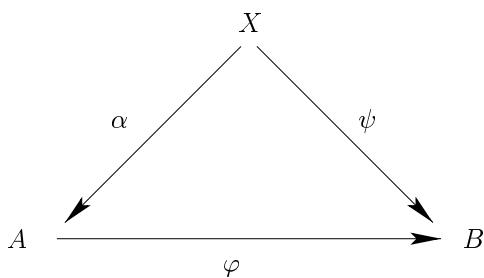
Figure 1.3 Monomorphism ϕ
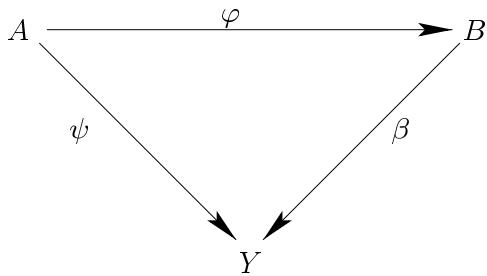
Figure 1.4 Epimorphism ϕ
On the other hand, is an epimorphism if the morphism is uniquely defined in the commutative diagram shown on Fig. 1.4.
Monomorphisms in the category of sets
In the case of the category of sets a morphism is a monomorphism if and only if it is a one-to-one mapping.
Proof
- is one-to-one then for any pair of maps and
for all . This is simply another way of stating the monomorphism property
- Conversely, suppose is a monomorphism. Since X is an arbitrary set, in the definition of the monomorphism property, we may choose it to be a singleton . For any pair of points define the maps α, by setting and . Then
Hence is one-to-one.
It is left as a problem to show that in the category of sets a morphism is an epimorphism if and only if it is surjective. A morphism is called an isomorphism if there exists a morphism such that
In the category of sets a mapping is an isomorphism if and only if it is bijective; that is, it is both an epimorphism and a monomorphism. There can, however, be a trap for the unwary here. While every isomorphism is readily shown to be both a monomorphism and an epimorphism, the converse is not always true. A classic case is the category of Hausdorff topological spaces in which there exist continuous maps that are epimorphisms and monomorphisms but are not invertible. The interested reader is referred to [11] for further development of this subject.
Problems
Show that in the category of sets a morphism is an epimorphism if and only if it is onto (surjective).
Show that every isomorphism is both a monomorphism and an epimorphism.